
 +91 83682 81897
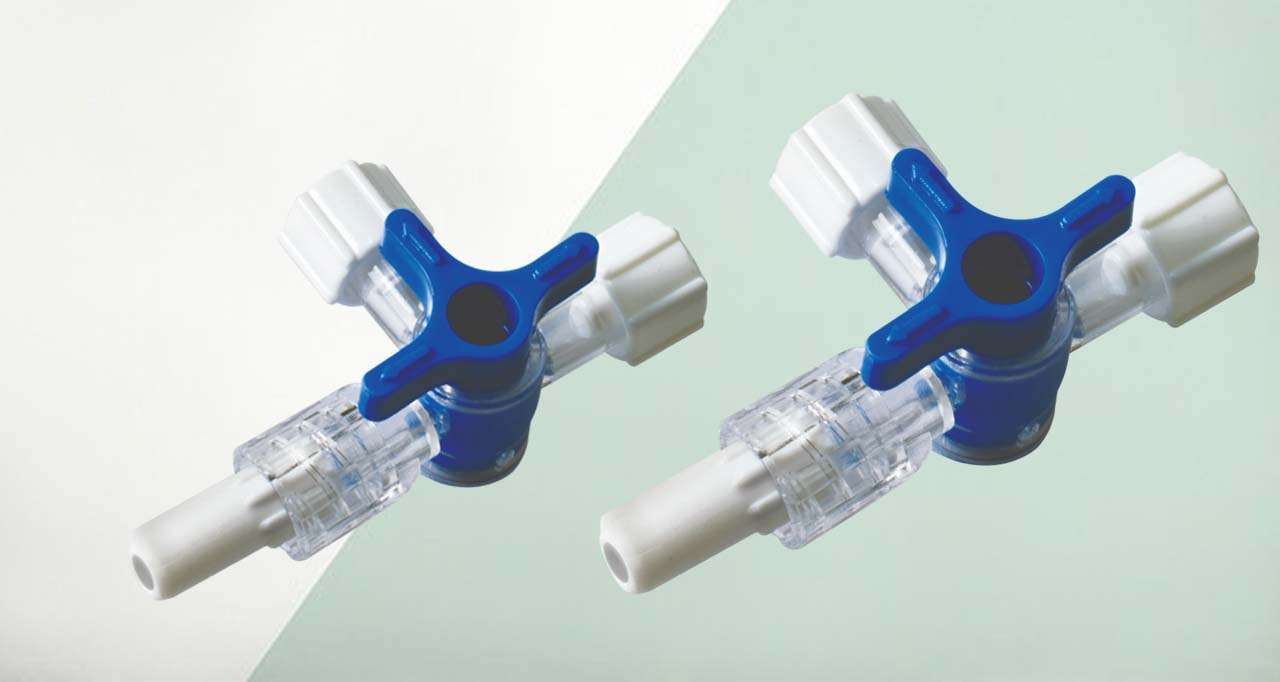
A 3-way stopcock is a valve with three ports and an adjustable tap (handle) that can be rotated to control the direction of fluid flow between any two or all three connected ports. It acts as a fluid pathway controller, allowing fluids to flow from one point to another, stop flow completely, or permit flow between all ports.
Key Features of a 3-Way Stopcock
Three Ports (Luer Lock or Luer Slip)
- Typically marked as A, B, and C.
- Connect to syringes, IV lines, catheters, or infusion devices.
- Universal luer lock compatibility ensures secure, leak-proof connections.
Rotating Handle (Tap)
- Can rotate 360° to allow, block, or divert flow.
- Often color-coded (usually blue or red) for easy identification.
- Clearly marked arrows or symbols indicate flow direction.
High-Pressure Compatibility
- Many models withstand up to 4.5 bar (65 psi) or more.
- Suitable for pressure infusions and contrast media injections.
Transparent Body
- Enables visual confirmation of fluid flow or air bubbles.
Leak-Proof & Sterile Design
- Individually packaged in sterile pouches.
- Designed to prevent backflow and leakage during usage.
Option for Extension Tubing
- Some variants come with integrated extension lines for added flexibility.
Material
- Made from medical-grade, DEHP-free, latex-free polycarbonate or polyethylene for patient safety and biocompatibility.
Benefits of a 3-Way Stopcock
Fluid Flow Control & Direction Management
- Simplifies the control of fluids between IV lines, syringes, and other devices.
- Reduces the need for disconnecting and reconnecting lines.
Multiple Access Points
- Allows administration of IV medications, fluids, or contrast media without disconnecting the primary line.
- Enables blood sampling or pressure monitoring simultaneously.
Improved Infection Control
- Minimizes manipulation of the IV line, reducing infection risk.
- Disposable and sterile versions prevent cross-contamination.
Reduces Line Complexity
- Centralizes control of fluid pathways in one device.
- Decreases the number of lines needed, reducing patient discomfort and line clutter.
Time-Saving for Healthcare Workers
- Speeds up procedures by offering quick flow control and line switching.
Patient Comfort & Safety
- Fewer line insertions and reduced handling lead to less pain, trauma, and better overall patient care.
Cost-Effective
- Reduces the need for multiple connections and repeated device handling, lowering equipment and labor costs.
Typical Applications
- Intravenous therapy (IV fluids and medications)
- Invasive blood pressure monitoring
- Blood sampling
- Radiology (contrast media administration)
- Intensive care and anesthesia procedures
- Infusion of multiple medications simultaneously
Types of 3-way stopcock
The 3-way stopcock comes in several types and variants, depending on its specific design, functionality, pressure capacity, port configuration, and intended use. These variations allow for flexible applications in different clinical settings such as IV therapy, anesthesia, critical care, and diagnostic procedures.
Standard 3-Way Stopcock
- Description: The most commonly used type with three luer ports and a rotatable tap.
- Applications: General IV infusions, fluid sampling, or medication administration.
- Key Feature: Simple flow control with clear directional arrow on the tap.
3-Way Stopcock with Extension Tube
- Description: Integrated with a flexible extension line (lengths vary: 10–150 cm).
- Applications: Enhances mobility and access in difficult-to-reach IV sites.
- Key Feature: Reduces tension on catheter/IV insertion site; ideal for ICU or pediatric use.
High-Pressure 3-Way Stopcock
- Description: Specially designed to withstand high injection pressures, usually up to 4.5–7 bar (65–100 psi).
- Applications: CT/MRI contrast media injection, pressure infusions.
- Key Feature: Robust, pressure-resistant material (often polycarbonate).
3-Way Stopcock with Lipid-Resistant Material
- Description: Built with lipid- and drug-resistant polymers (e.g., for TPN or chemotherapy).
- Applications: Long-term nutrition (Total Parenteral Nutrition), aggressive drug infusion.
- Key Feature: Chemically resistant, prevents cracking/degradation from lipophilic drugs.
3-Way Stopcock with Rotating Luer Lock
- Description: One or more ports have rotatable luer locks for easy tubing connection without twisting the whole assembly.
- Applications: Situations requiring frequent connection/disconnection (e.g., emergency care).
- Key Feature: Reduces kinking and strain on IV lines.
3-Way Stopcock with Fixed Luer Lock
- Description: All ports are fixed (non-rotating).
- Applications: Standard setups where connections remain undisturbed.
- Key Feature: More rigid connection, typically lower cost.
3-Way Stopcock with Color-Coded Handles
- Description: Taps are color-coded to indicate purpose:
Blue – general use
Red – arterial
White – universal
- Applications: Multiline infusion setups, critical care units.
- Key Feature: Helps quickly identify lines and avoid medication errors. Description: Taps are color-coded to indicate purpose:
3-Way Stopcock with One-Way Valve or Anti-Reflux Valve
- Description: Integrated with check valve to prevent backflow.
- Applications: Infusions where reflux must be prevented (e.g., when multiple medications are used).
- Key Feature: Enhances safety by preventing contamination and air embolism.
3-Way Stopcock with Needle-Free Injection Port
- Description: Comes with an integrated needleless port (like a septum) for syringe access.
- Applications: Medication administration or sampling without using needles.
Key Feature: Minimizes needle-stick injuries, enhances infection control.