
 +91 83682 81897
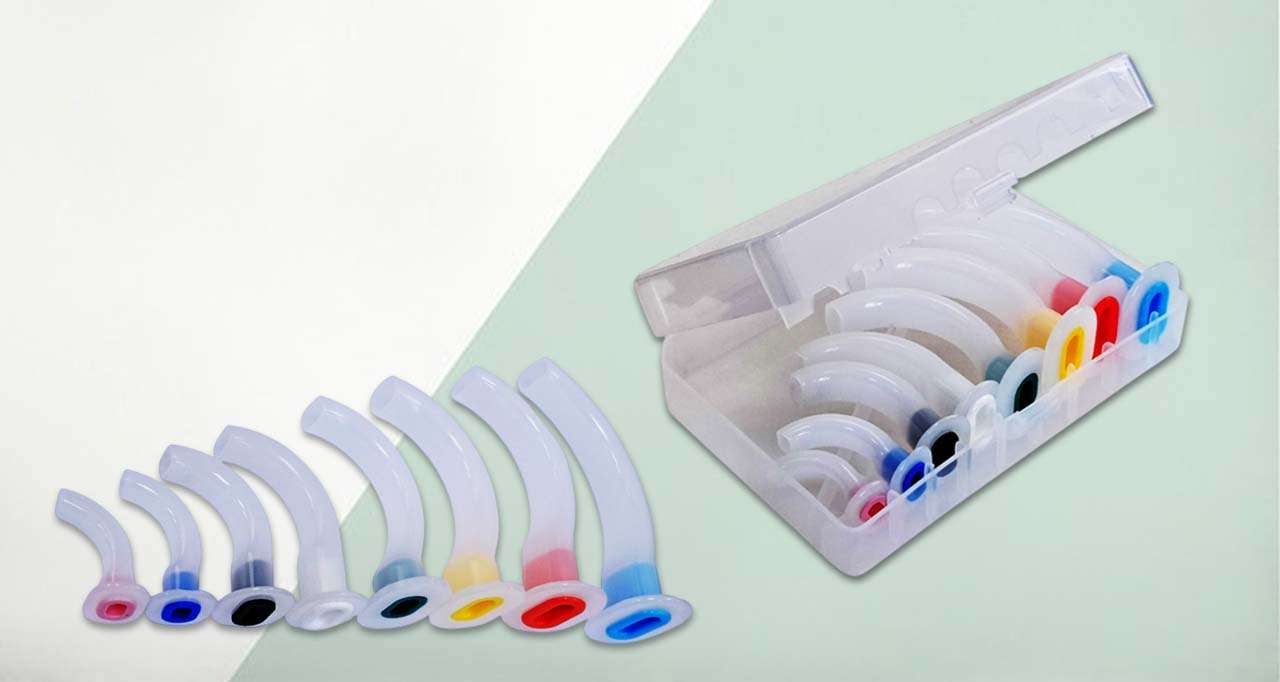
A Guedel airway is a curved plastic tube inserted into the mouth to keep the airway open by preventing the tongue from blocking the throat. It is mainly used in unconscious patients who are not able to keep their airway clear on their own.
Uses of Guedel Airways
Maintaining a Patent Airway in Unconscious Patients
- The primary use of a Guedel airway is to prevent the tongue from obstructing the airway in unconscious or semi-conscious patients.
- In these states, muscle tone is lost, and the tongue can fall back against the posterior pharyngeal wall, blocking airflow.
- The Guedel airway lifts and displaces the tongue anteriorly, keeping the oropharyngeal passage open for spontaneous or assisted ventilation.
Airway Management During General Anesthesia
- During surgical procedures under general anesthesia, patients often lose protective airway reflexes.
- The Guedel airway is inserted to:
- Ensure a clear passage for oxygen delivery or anesthetic gases.
- Prevent airway obstruction due to tongue or soft tissue collapse.
- Allow manual ventilation via a bag-valve-mask (BVM) or anesthesia machine.
Facilitating Manual Ventilation (Bag-Valve-Mask Resuscitation)
In emergency resuscitation, especially during CPR, the Guedel airway:
-
- Assists in opening the airway quickly.
- Facilitates effective ventilation with a BVM device.
- Minimizes the risk of gastric insufflation by improving air direction into the lungs.
Aiding Suctioning of Oropharyngeal Secretions
- In unconscious patients, accumulation of oral secretions is common.
- The central lumen of the Guedel airway allows for:
- Suction catheter insertion through the device.
- Clearing secretions, vomitus, or blood without needing to remove the device.
As a Bite Block
The Guedel airway includes a built-in bite block, especially useful when:
-
- Patients are emerging from anesthesia and may bite down involuntarily.
- During seizure activity, it helps prevent tongue injury or dental damage.
- It protects airway adjuncts like endotracheal tubes during mask ventilation.
Pre-Hospital Emergency Care (EMS, Ambulance Use)
Widely used in pre-hospital care, especially in:
-
- Road traffic accidents
- Cardiac arrest scenarios
- Drug overdose or trauma
EMS personnel use it to rapidly establish a patent airway until more definitive measures (like intubation) can be done.
Bridge to Advanced Airway Management
In emergency settings, the Guedel airway often serves as a temporary measure before:
-
- Endotracheal intubation
- Supraglottic airway placement (like LMA)
It stabilizes the airway and ensures oxygenation during the transition to definitive airway care.
Assisting in Airway Assessment & Sizing
Guedel airways also help in measuring and practicing airway size selection for:
-
- Medical students and paramedics in training
- Simulations and emergency drills
Important Clinical Considerations:
- Not suitable for conscious or semi-conscious patients due to the gag reflex.
- Must be properly sized (measure from the corner of the mouth to the angle of the jaw).
- Inappropriate use or incorrect size may lead to airway trauma, vomiting, or ineffective ventilation.
Complications of the Guedel airway
The Guedel airway (oropharyngeal airway) is generally a safe and effective device when used correctly. However, complications can occur, especially if it’s improperly sized, inserted, or used inappropriately. Below is a detailed overview of the potential complications associated with its use:
Gagging and Vomiting
If used in a conscious or semi-conscious patient, it can stimulate the gag reflex, leading to:
-
- Nausea or vomiting
- Risk of aspiration of stomach contents into the lungs
This is why Guedel airways are contraindicated in patients with intact airway reflexes.
Airway Trauma or Mucosal Injury
Forceful or improper insertion can cause:
-
- Lacerations, bruising, or abrasions to the soft palate, tongue, or pharyngeal mucosa
- Bleeding from the oropharyngeal tissues
Oversized airways can exert excessive pressure, while undersized ones may move and rub against tissues.
Dental Damage
In patients with loose teeth or poor dentition, the rigid plastic bite block can:
-
- Dislodge or break teeth
- Lead to aspiration of broken dental fragments
Risk increases if the patient bites down involuntarily during partial consciousness or seizures.
Obstruction Instead of Relief
If the airway is:
-
- Too small: The tongue may still fall back and obstruct the airway.
- Too large: It may push the epiglottis downward and actually worsen the obstruction.
Incorrect placement may also cause partial blockage of airflow.
Laryngospasm
Rare but serious, especially in semi-conscious patients:
-
- Contact with the posterior pharyngeal wall may trigger a reflex spasm of the vocal cords, leading to airway closure.
- This can result in respiratory distress or arrest.
Aspiration of the Device
-
- If the airway becomes dislodged or broken, parts may be inhaled or swallowed.
- This is more likely with low-quality or reused single-use devices.
Pressure Injuries (Ulceration or Necrosis)
Prolonged use without periodic removal can cause:
-
- Pressure sores on the tongue, palate, or oropharyngeal tissues
- In extreme cases, tissue necrosis
Often occurs in ICU patients when the airway is left in place too long.
Induced Coughing or Choking
Even in lightly sedated patients, insertion may cause:
-
- Coughing, choking, or distress
- May lead to agitation, hypoxia, or increased intracranial pressure in neurologically vulnerable patients
How to Prevent These Complications?
- Use only in fully unconscious patients without gag reflex
- Correct sizing: Measure from the corner of the mouth to the angle of the jaw
- Gentle insertion: Rotate during placement to avoid soft tissue damage
- Monitor continuously: Especially during anesthesia or resuscitation
- Remove or reposition periodically in long-term use
- Avoid reusing single-use airways to prevent structural degradation
Benefits of Guedel Airways
Maintains a Clear Airway
- Prevents the tongue from falling backward and obstructing the airway, especially in unconscious patients.
- Keeps the oropharyngeal passage open, allowing unimpeded airflow during spontaneous or assisted breathing
Facilitates Effective Ventilation
Improves the efficiency of bag-valve-mask (BVM) ventilation by:
- Creating a clear path for air to reach the lungs.
- Reducing resistance from soft tissue collapse.
- Critical during CPR, resuscitation, and anesthesia induction.
Simple, Quick, and Easy to Use
- Requires minimal training to insert correctly.
- Can be quickly deployed in emergency situations or field settings.
- Non-invasive and avoids the complexity of advanced airway procedures (e.g., intubation).
Supports Suctioning
- The central lumen (air channel) allows easy insertion of suction catheters.
- Facilitates removal of secretions, vomitus, or blood from the oropharynx.
- Helps maintain airway hygiene in unconscious or sedated patients.
Prevents Dental and Tongue Injury
The built-in bite block protects against:
-
- Involuntary biting of the tongue.
- Damage to dental structures.
- Compression of or obstruction to other airway devices during ventilation.
Enables Safe Use of Anesthesia
- Helps maintain airway patency during general anesthesia, when reflexes are suppressed.
- Reduces the risk of airway obstruction in anesthetized patients during surgery.
Readily Available in Multiple Sizes
- Available in color-coded, standardized sizes to fit all age groups (from neonates to adults).
- Simplifies selection and ensures better patient-specific airway management.
Cost-Effective
- Inexpensive and widely available.
- Often supplied in single-use sterile packs, reducing risk of infection and eliminating cleaning needs.
- Ideal for resource-limited settings, ambulances, and field hospitals.
Bridge to Advanced Airway Techniques
- Can be used as a temporary airway adjunct until:
- Endotracheal intubation is performed.
- A supraglottic airway (e.g., LMA) is placed.
- Maintains oxygenation during transitions.
Useful in Training and Simulation
- Widely used for teaching airway management to medical students, nurses, paramedics, and anesthesiologists.
- Enhances hands-on practice of sizing, insertion, and ventilation techniques.