
 +91 83682 81897
Laboratories rely on a wide range of tools and accessories to ensure safe, accurate, and efficient scientific work. While advanced instruments like micropipettes, analytical balances, and automated analyzers often receive the most attention, small yet essential components play an equally important role in daily laboratory operations. One such indispensable item is the rubber stopper.
Rubber stoppers are a fundamental part of laboratory ware, used across chemistry, biology, medical, pharmaceutical, and educational laboratories. Their primary function is to seal laboratory containers, prevent contamination, control chemical reactions, and ensure safety during experiments. Despite their simple appearance, rubber stoppers significantly contribute to laboratory efficiency and accuracy.
Understanding Rubber Stoppers in Laboratory Use
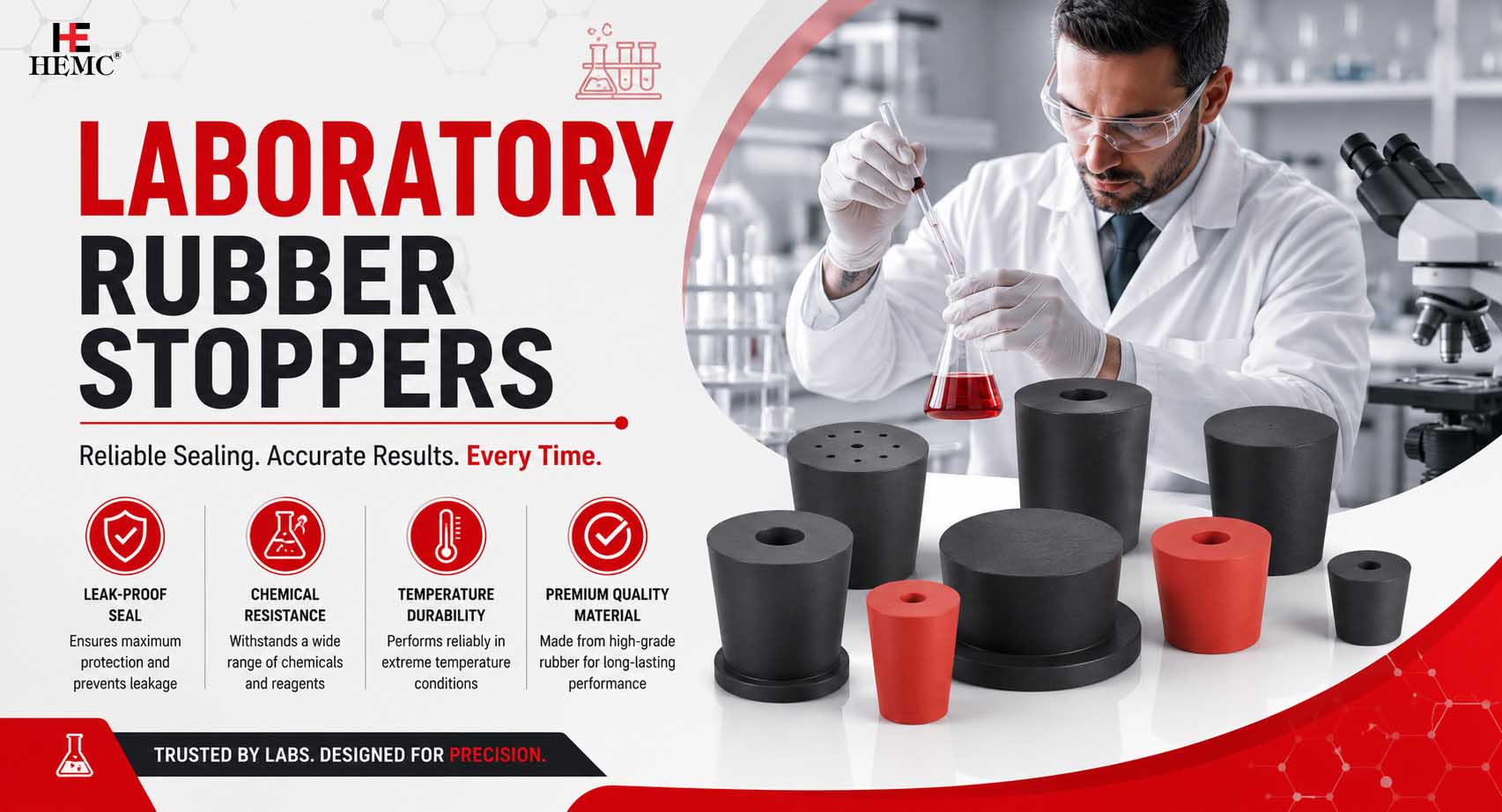
A rubber stopper is a small laboratory accessory made from natural or synthetic rubber designed to fit tightly into the openings of laboratory glassware such as test tubes, flasks, and bottles. Rubber stoppers are used to seal containers, hold instruments in place, or allow controlled passage of gases and liquids.
As part of standard laboratory ware, rubber stoppers support experimental integrity by preventing leaks, reducing evaporation, and protecting samples from environmental contamination.
Importance of Rubber Stoppers in Laboratory Operations
Rubber stoppers play a critical role in maintaining controlled laboratory environments. Whether used in research laboratories, academic institutions, or diagnostic facilities, these stoppers ensure that experiments are conducted safely and accurately.
They are commonly used alongside other laboratory tools such as micropipettes, spatula, lab thermometers, and volumetric glassware, forming a complete and functional laboratory setup.
Key Roles of Rubber Stoppers in the Laboratory
Sealing Laboratory Containers
One of the primary roles of rubber stoppers is to provide an airtight or liquid-tight seal for laboratory glassware. Test tubes, conical flasks, round-bottom flasks, and reagent bottles often require secure closures during experiments.
By sealing containers effectively, rubber stoppers:
- Prevent spillage of chemicals
- Reduce evaporation of volatile substances
- Protect samples from dust, moisture, and microbial contamination
This sealing function is crucial in both short-term experiments and long-term sample storage.
Supporting Controlled Chemical Reactions
Many laboratory reactions require controlled environments where gases or vapors must be contained or directed. Rubber stoppers with one or more holes allow the insertion of glass tubing, thermometers, or delivery tubes.
For example:
- A lab thermometer can be inserted through a holed rubber stopper to monitor temperature during heating
- Gas delivery tubes can pass through stoppers to guide gases into or out of reaction vessels
This versatility makes rubber stoppers essential for experimental setups in chemistry and physics laboratories.
Enhancing Laboratory Safety
Safety is a top priority in laboratory environments. Rubber stoppers help minimize exposure to hazardous chemicals by sealing containers and preventing accidental splashes or vapor release.
When used correctly, rubber stoppers:
- Reduce the risk of chemical spills
- Limit exposure to toxic fumes
- Help maintain a clean and organized workspace
They complement other safety-oriented laboratory ware and protective equipment to create a safer laboratory environment.
Preventing Contamination in Biological and Medical Laboratories
In biological and medical laboratories, contamination control is essential. Rubber stoppers are used to protect culture media, reagents, and biological samples from airborne contaminants.
In combination with sterile laboratory plastic ware such as petri dishes, centrifuge tubes, and sample containers, rubber stoppers support aseptic techniques and reliable experimental results.
Assisting in Sample Storage and Preservation
Rubber stoppers are widely used for sealing sample containers during storage. They help preserve the integrity of samples by maintaining stable internal conditions.
This role is especially important in laboratories where samples are stored for extended periods before analysis. Proper sealing ensures that sample composition remains unchanged, supporting accurate results when using analytical tools like micropipettes and spectrophotometers.
Types of Rubber Stoppers Used in Laboratories
Rubber stoppers are available in various designs to meet different laboratory needs.
Solid Rubber Stoppers
These stoppers have no holes and are used primarily for sealing containers. They are ideal for storage and transport of liquids and chemicals.
One-Hole Rubber Stoppers
These feature a single hole to accommodate thermometers, glass tubing, or delivery tubes. They are commonly used in experiments requiring temperature monitoring or gas transfer.
Multi-Hole Rubber Stoppers
Multi-hole stoppers allow multiple instruments or tubes to pass through simultaneously, supporting more complex experimental setups.
Tapered Rubber Stoppers
Designed to fit a range of container sizes, tapered stoppers provide flexibility and ease of use.
Materials Used in Rubber Stoppers
Rubber stoppers are manufactured from different materials depending on their intended application.
Natural Rubber
Natural rubber stoppers are flexible and provide excellent sealing properties. They are suitable for general laboratory use but may have limited chemical resistance.
Synthetic Rubber
Synthetic materials such as neoprene or silicone offer improved resistance to chemicals, heat, and aging. Silicone stoppers are especially useful in high-temperature applications.
Selecting the appropriate material is essential for ensuring compatibility with chemicals and laboratory conditions.
Rubber Stoppers and Their Compatibility with Laboratory Equipment
Rubber stoppers are often used in conjunction with a wide range of laboratory tools and accessories.
- Micropipettes are used to transfer precise volumes of liquids from containers sealed with rubber stoppers.
- Spatula are used to handle solid chemicals before containers are sealed for storage.
- Lab thermometers pass through holed stoppers to measure reaction temperatures.
- Glass tubing and condensers rely on rubber stoppers for secure connections.
This compatibility highlights the integrative role of rubber stoppers within the broader category of laboratory ware.
Rubber Stoppers vs Laboratory Plastic Ware
While laboratory plastic ware such as screw-cap bottles and plastic closures offer convenience, rubber stoppers provide unique advantages in experimental flexibility. Unlike fixed caps, rubber stoppers can be customized with holes to suit specific experimental requirements.
This makes them especially valuable in educational and research laboratories where experiments frequently change.
Advantages of Using Rubber Stoppers in the Laboratory
Versatility
Rubber stoppers can be used across multiple disciplines and experimental setups.
Cost-Effectiveness
They are affordable and reusable, making them a practical choice for laboratories of all sizes.
Ease of Use
Rubber stoppers are easy to insert, remove, and modify.
Reliability
They provide consistent sealing performance when properly selected and maintained.
Maintenance and Care of Rubber Stoppers
To ensure long-term performance, rubber stoppers should be:
- Cleaned thoroughly after use
- Stored away from direct sunlight and extreme temperatures
- Inspected regularly for cracks or hardening
- Proper maintenance ensures that rubber stoppers remain effective components of laboratory ware.
Role of Rubber Stoppers in Educational Laboratories
In schools and colleges, rubber stoppers are widely used in demonstration experiments and student practicals. They help students understand experimental setups involving gas collection, temperature measurement, and controlled reactions.
Their simplicity and reliability make them ideal teaching tools alongside basic laboratory items such as micropipettes, spatula, and lab thermometers.
Conclusion
Rubber stoppers may appear to be simple laboratory accessories, but their role in laboratory operations is both significant and multifaceted. From sealing containers and supporting controlled reactions to enhancing safety and preventing contamination, rubber stoppers are essential components of modern laboratory ware.
Their compatibility with laboratory plastic ware, micropipettes, spatula, lab thermometers, and other laboratory equipment highlights their importance in creating efficient and reliable laboratory workflows. Whether in research, education, or diagnostics, rubber stoppers continue to be indispensable tools that support accurate, safe, and effective scientific work.