
 +91 83682 81897
Cold Chain Equipment plays a critical role in maintaining the quality, safety, and effectiveness of temperature-sensitive medical products such as vaccines, biological samples, pharmaceuticals, blood products, and laboratory reagents. By maintaining the required temperature throughout storage and transportation, cold chain systems ensure that vaccines and medicines remain potent until they reach healthcare providers and patients.
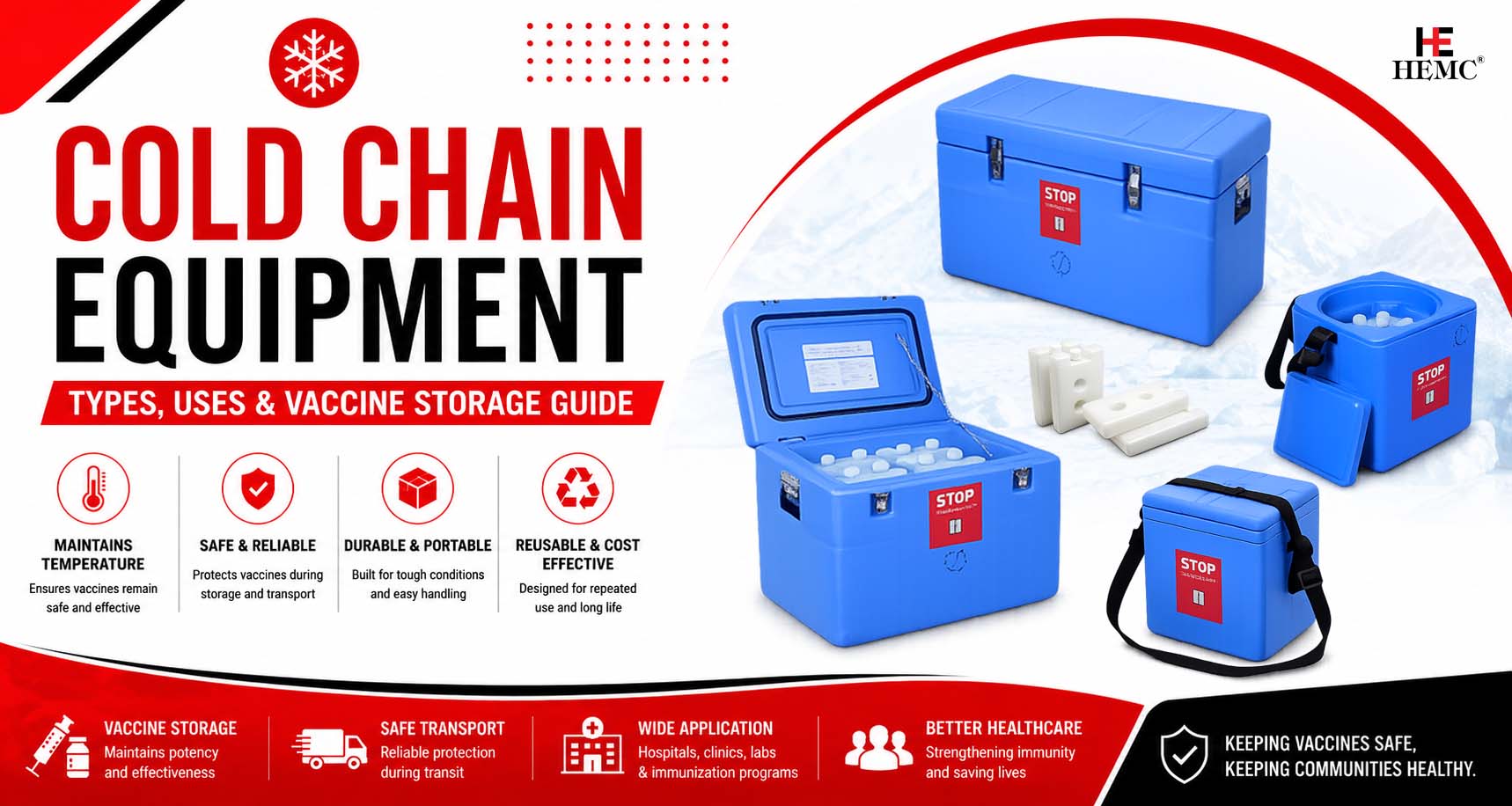
From national immunisation programmes to hospitals, diagnostic laboratories, pharmaceutical companies, and rural healthcare centres, reliable cold chain equipment is essential for preserving life-saving medical products. Equipment such as cold boxes, cold box large, cold box small, Vaccine Carriers, Vaccine Carrier Large, Vaccine Carrier small, and Ice Pack solutions form the backbone of vaccine transportation and storage systems worldwide.
This comprehensive guide explains the different types of cold chain equipment, their applications, benefits, maintenance, and how to choose the right products for your healthcare facility.
What is Cold Chain Equipment?
Cold Chain Equipment refers to specialised insulated containers and cooling accessories designed to maintain a controlled temperature during the storage and transportation of vaccines and other temperature-sensitive medical supplies.
Most vaccines require storage between +2°C and +8°C, and any exposure to temperatures outside this range can reduce their effectiveness. Cold chain equipment helps maintain these temperatures from the manufacturer to the point of administration.
Cold chain systems are widely used in:
- Hospitals
- Primary Health Centres
- Vaccination Clinics
- Government Immunisation Programmes
- Pharmaceutical Companies
- Diagnostic Laboratories
- Blood Banks
- Medical Research Institutions
- Veterinary Healthcare
- Disaster Relief Operations
Importance of Cold Chain Equipment
Vaccines and biological products are highly sensitive to temperature fluctuations. If they become too warm or freeze unintentionally, their effectiveness can be permanently damaged.
Reliable cold chain equipment helps:
- Maintain vaccine potency
- Reduce product wastage
- Improve immunisation success
- Protect public health
- Ensure compliance with healthcare standards
- Support safe transportation in remote areas
- Preserve laboratory samples
Without an efficient cold chain, immunisation programmes may experience reduced vaccine effectiveness, resulting in increased healthcare costs and preventable disease outbreaks.
Types of Cold Chain Equipment
Several products are designed to meet different transportation and storage requirements.
Cold Boxes
Cold boxes are insulated containers specifically designed for transporting vaccines and medicines over extended periods. They use frozen Ice Pack units to maintain internal temperatures during transit.
Cold boxes are commonly used during vaccine distribution from central storage facilities to regional hospitals, clinics, and outreach programmes.
Features
- High-density insulated construction
- Long temperature retention
- Durable outer shell
- Leak-resistant design
- Easy carrying handles
- Suitable for multiple Ice Packs
- Reusable construction
Applications
- Vaccine transportation
- Emergency medical supply transport
- Disaster relief
- Public health campaigns
- Pharmaceutical logistics
Cold Box Large
A cold box large is designed for transporting larger quantities of vaccines or medicines over long distances. These units provide extended cooling performance and higher storage capacity.
Advantages
- Large internal volume
- Extended cold retention
- Heavy-duty insulation
- Suitable for bulk vaccine transportation
- Durable construction for repeated use
Ideal Uses
- State vaccine depots
- District hospitals
- National immunisation programmes
- Pharmaceutical distribution centres
Cold Box Small
The cold box small offers a compact solution for transporting smaller vaccine quantities while maintaining required temperatures.
These models are lightweight, portable, and ideal for mobile healthcare workers.
Benefits
- Easy to carry
- Lightweight
- Excellent insulation
- Convenient for outreach programmes
- Cost-effective
Common Applications
- Rural vaccination camps
- Mobile health units
- Primary healthcare centres
- Community immunisation drives
Vaccine Carriers
Vaccine Carriers are portable insulated containers specifically designed for transporting vaccines during immunisation sessions.
They are smaller than cold boxes and are commonly used by healthcare workers travelling to remote communities.
Features
- Compact design
- Lightweight construction
- Comfortable carrying handle
- High-quality insulation
- Compatible with Ice Pack cooling
Applications
- Vaccination campaigns
- Field immunisation
- Mobile healthcare services
- Door-to-door vaccination
Vaccine Carrier Large
The Vaccine Carrier Large offers additional storage capacity while maintaining excellent temperature stability.
It is ideal for healthcare teams conducting high-volume vaccination programmes.
Advantages
- Larger vaccine capacity
- Long cooling duration
- Easy transportation
- Rugged construction
- Suitable for extended field operations
Used In
- Government immunisation drives
- Hospital outreach programmes
- Rural healthcare
- International health missions
Vaccine Carrier Small
The Vaccine Carrier small is perfect for transporting limited vaccine quantities for short-duration immunisation sessions.
Healthcare workers appreciate its lightweight construction and ease of handling.
Features
- Compact size
- Easy portability
- Durable insulation
- Quick access lid
- Reliable temperature maintenance
Suitable For
- Local clinics
- Home vaccination visits
- School immunisation
- Community healthcare
Ice Pack
The Ice Pack is one of the most important components of every cold chain system. These reusable cooling packs are frozen before use and placed inside cold boxes or vaccine carriers to maintain the desired temperature.
Features
- Reusable design
- Leak-proof construction
- Durable plastic casing
- Long cooling performance
- Easy freezing
- Available in multiple sizes
Benefits
- Maintains cold temperature
- Reduces temperature fluctuations
- Cost-effective
- Easy to clean
- Long service life
Applications of Cold Chain Equipment
Cold chain equipment serves numerous healthcare sectors.
Immunisation Programmes
National vaccination campaigns depend heavily on cold boxes, Vaccine Carriers, and Ice Pack systems for safe vaccine transportation.
Hospitals
Hospitals transport vaccines, medicines, blood products, and biological specimens while maintaining required storage temperatures.
Pharmaceutical Industry
Manufacturers distribute temperature-sensitive medicines using insulated cold chain solutions.
Diagnostic Laboratories
Laboratories transport blood samples, reagents, and biological specimens safely between collection centres and testing facilities.
Veterinary Medicine
Cold chain equipment preserves veterinary vaccines used for livestock and companion animals.
Emergency Relief
During natural disasters or humanitarian missions, portable cold boxes ensure vaccines remain effective despite limited infrastructure.
Key Features of High-Quality Cold Chain Equipment
Selecting reliable equipment requires understanding several important features.
Excellent Thermal Insulation
High-density insulation minimises heat transfer and maintains internal temperatures for extended periods.
Durable Construction
Impact-resistant outer shells ensure long service life even under demanding field conditions.
Lightweight Design
Portable construction simplifies transportation during outreach programmes.
Leak-Proof Design
Quality equipment prevents water leakage from melting Ice Pack units.
Easy Cleaning
Smooth interior surfaces simplify cleaning and disinfection.
Long Temperature Retention
Premium cold chain equipment maintains safe temperatures for several hours or even days, depending on the model.
How Cold Chain Equipment Works
Cold chain equipment uses passive cooling technology.
The process involves:
- Freeze the Ice Pack according to recommended guidelines.
- Arrange Ice Packs inside the cold box or Vaccine Carrier.
- Place vaccines in protective containers.
- Close the insulated lid securely.
- Minimise lid opening during transportation.
- Monitor temperatures throughout the journey.
This system helps maintain vaccine potency during transport
Benefits of Cold Chain Equipment
Investing in quality cold chain equipment provides numerous advantages.
- Preserves vaccine effectiveness
- Minimises wastage
- Supports national immunisation programmes
- Reliable performance
- Easy transportation
- Long product life
- Low maintenance
- Reusable components
- Cost-effective operation
- Improved patient safety
Choosing the Right Cold Chain Equipment
Different healthcare facilities have different requirements.
| REQUIREMENT |
RECOMMENDED EQUIPMENT
|
| Large vaccine transport |
Cold Box Large
|
| Small outreach programme |
Cold Box Small
|
| Mobile vaccination |
Vaccine Carrier
|
| High-volume immunisation |
Vaccine Carrier Large
|
| Local field visits |
Vaccine Carrier Small
|
| Temperature maintenance |
Ice Pack
|
When selecting equipment, consider:
- Storage capacity
- Duration of transportation
- Frequency of use
- Number of vaccines transported
- Environmental conditions
- Ease of handling
Maintenance Tips
Proper maintenance extends equipment life and ensures reliable performance.
- Clean equipment after every use.
- Inspect seals regularly.
- Replace damaged Ice Packs.
- Store equipment in a dry location.
- Freeze Ice Packs properly before use.
- Avoid dropping insulated containers.
- Check lids for secure closure.
- Inspect insulation for cracks or damage.
Routine maintenance ensures dependable temperature control during every transport cycle.
Future of Cold Chain Technology
Advancements in cold chain technology continue to improve vaccine transportation and storage. Modern systems increasingly incorporate digital temperature monitoring, GPS tracking, smart data loggers, and enhanced insulation materials. These innovations allow healthcare providers to monitor temperature conditions in real time, respond quickly to deviations, and improve overall supply chain efficiency. As global immunisation efforts expand, advanced cold chain equipment will play an even greater role in ensuring safe and reliable vaccine delivery.
Conclusion
Cold Chain Equipment is an essential component of modern healthcare logistics, ensuring that vaccines, medicines, biological samples, and temperature-sensitive products remain safe and effective from manufacture to administration. Products such as cold boxes, cold box large, cold box small, Vaccine Carriers, Vaccine Carrier Large, Vaccine Carrier small, and Ice Pack solutions provide dependable temperature control for hospitals, laboratories, pharmaceutical companies, and immunisation programmes.
By choosing high-quality cold chain equipment and following proper handling and maintenance practices, healthcare organisations can minimise product loss, maintain vaccine potency, and support successful immunisation initiatives. Reliable cold chain solutions not only protect valuable medical supplies but also contribute to better patient outcomes and stronger public health systems.