
 +91 83682 81897
Microscopes are among the most essential scientific instruments used in laboratories, educational institutions, research centres, hospitals, and industrial quality control departments. They allow users to observe tiny structures that are invisible to the naked eye, making them indispensable in biology, microbiology, pathology, medicine, pharmaceuticals, metallurgy, electronics, and material science.
Whether you are a student learning the basics of biology or a professional researcher conducting advanced laboratory investigations, selecting the right microscope significantly impacts observation quality and research accuracy. Modern microscopes are designed with high-quality optical systems, ergonomic features, LED illumination, and precision focusing mechanisms to deliver clear, high-resolution images.
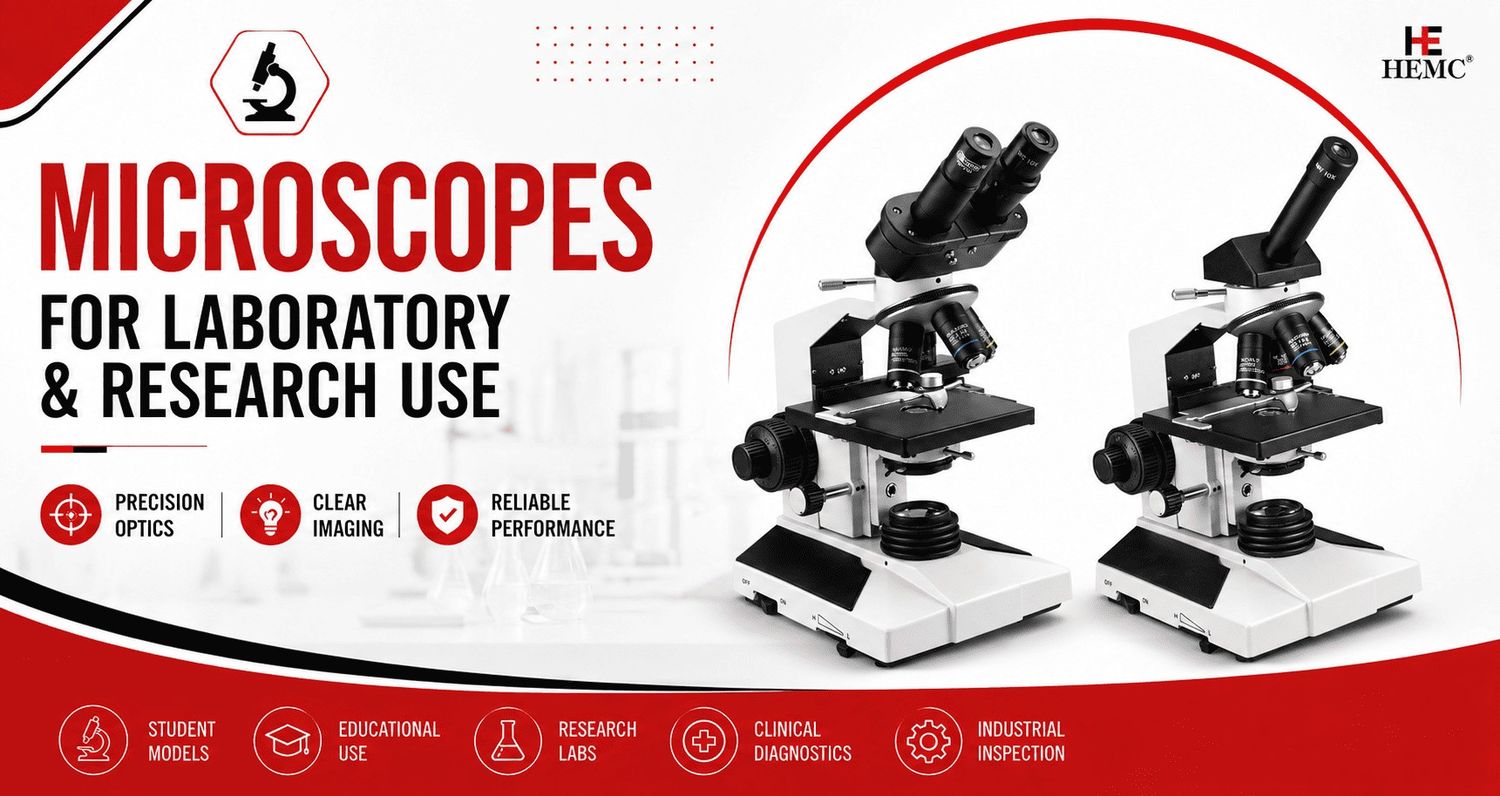
This comprehensive guide explores the different types of microscopes, their applications, key features, and how to choose the best microscope for your specific needs. It also covers popular laboratory models, including the Binocular Microscope Co-Axial, Binocular Microscope Research, Co-Axial Monocular Microscope, Monocular Microscope Research Inclined, Microscope Student, and Dissecting Microscope.
What is a Microscope?
A microscope is an optical instrument designed to magnify very small objects so they can be examined in detail. It combines multiple lenses and illumination systems to enlarge specimens while maintaining clarity and precision.
Microscopes are widely used for:
- Medical diagnostics
- Biological research
- Educational demonstrations
- Histopathology
- Microbiology
- Veterinary science
- Forensic investigations
- Industrial inspection
- Electronics manufacturing
- Quality control laboratories
Depending on the application, microscopes may use optical lenses, digital imaging systems, fluorescence technology, or electron beams to achieve varying levels of magnification.
Importance of Microscopes in Modern Laboratories
Microscopes play a vital role in scientific discovery and diagnostic procedures. Healthcare professionals use them to identify bacteria, fungi, parasites, and abnormal cells, while researchers rely on them to study microorganisms, tissues, and cellular structures.
Educational institutions use microscopes to provide practical learning experiences, enabling students to understand microscopic anatomy and biological processes more effectively.
Industrial laboratories also depend on microscopes for inspecting electronic components, precision engineering parts, textile fibres, and material defects.
Types of Microscopes
Different applications require different microscope designs. Understanding these types helps users select the most appropriate model.
Binocular Microscope Co-Axial
The Binocular Microscope Co-Axial is one of the most commonly used laboratory microscopes. It features two eyepieces, allowing comfortable viewing with both eyes while reducing eye strain during prolonged observation.
Its co-axial focusing system combines coarse and fine focusing knobs on the same axis, providing smooth and highly accurate adjustments.
Features
- Binocular viewing head
- Co-axial coarse and fine focusing
- High-quality achromatic objectives
- Mechanical stage
- LED or halogen illumination
- Comfortable ergonomic design
- Excellent image clarity
Applications
- Medical laboratories
- Pathology
- Histology
- Educational institutions
- Clinical diagnostics
- Pharmaceutical laboratories
Binocular Microscope Research
The Binocular Microscope Research is specifically designed for advanced scientific investigations. These microscopes offer superior optical performance, higher magnification options, precision focusing, and advanced illumination systems.
Research microscopes are commonly used in universities, biotechnology laboratories, hospitals, and pharmaceutical research facilities.
Advantages
- Superior optical resolution
- Long working hours with minimal eye fatigue
- Precision mechanical stage
- High numerical aperture objectives
- Optional camera attachment
- Advanced condenser system
Common Uses
- Cell biology
- Microbiology
- Pathology
- Research laboratories
- Pharmaceutical development
- Biotechnology
Co-Axial Monocular Microscope
The Co-Axial Monocular Microscope is an excellent choice for routine laboratory work and educational purposes. It offers reliable performance while remaining economical.
The co-axial focusing mechanism allows smooth focusing adjustments for improved viewing accuracy.
Key Features
- Single eyepiece design
- Co-axial focusing
- Durable metal body
- Easy operation
- Bright illumination
- High-quality objectives
Suitable For
- School laboratories
- Colleges
- Small diagnostic centres
- Veterinary clinics
- Basic biological research
Monocular Microscope Research Inclined
The Monocular Microscope Research Inclined provides an inclined viewing head that offers greater comfort during prolonged laboratory sessions.
Its precision optics and ergonomic design make it suitable for both educational and research environments.
Benefits
- Inclined viewing tube
- Better user comfort
- Sharp optical performance
- Stable mechanical construction
- Smooth focusing system
- Compact footprint
Applications
- Teaching laboratories
- Biological research
- Microbiology
- Clinical laboratories
Microscope Student
The Microscope Student model is specially designed for schools, colleges, and beginner laboratory users. It is simple to operate while providing excellent optical performance for educational purposes.
Student microscopes help learners understand microscopic organisms, plant cells, animal tissues, and microorganisms.
Features
- Lightweight construction
- User-friendly controls
- Durable design
- Affordable pricing
- Bright LED illumination
- Reliable magnification
Ideal For
- Schools
- Colleges
- Science laboratories
- Educational demonstrations
- Practical biology classes
Dissecting Microscope
A Dissecting Microscope, also known as a stereo microscope, provides a three-dimensional view of larger specimens at relatively low magnification.
Unlike compound microscopes, dissecting microscopes are used for observing external structures rather than internal cellular details.
Advantages
- Three-dimensional imaging
- Long working distance
- Large field of view
- Easy specimen handling
- Natural colour observation
Common Applications
- Entomology
- Botany
- Jewellery inspection
- Electronics assembly
- Quality control
- Forensic science
- Surgical training
Essential Components of a Microscope
Every microscope consists of several important components that contribute to image quality.
Eyepiece (Ocular Lens)
The eyepiece magnifies the image produced by the objective lens. Standard eyepieces usually provide 10x magnification.
Objective Lenses
Objective lenses determine the microscope’s primary magnification. Common options include:
- 4x
- 10x
- 40x
- 100x Oil Immersion
Stage
- The stage securely holds the specimen slide and allows accurate positioning during observation.
Mechanical Stage
- A mechanical stage enables precise movement of slides in both X and Y directions.
Condenser
- The condenser focuses light onto the specimen, improving brightness and resolution.
Iris Diaphragm
- The diaphragm regulates light intensity to optimise image contrast.
Illumination System
- Modern microscopes commonly use LED lighting due to its brightness, energy efficiency, and long service life.
Co-Axial Focusing
- Co-axial coarse and fine focus controls enable rapid and precise focusing without changing hand positions.
Applications of Microscopes
Microscopes are used across numerous industries.
Medical Diagnostics
Doctors and laboratory technicians use microscopes to examine:
- Blood samples
- Urine sediments
- Tissue sections
- Bacteria
- Parasites
- Fungal infections
Educational Institutions
Schools and colleges use microscopes for practical learning in:
- Biology
- Zoology
- Botany
- Anatomy
Pharmaceutical Industry
Microscopes assist in:
- Drug research
- Quality testing
- Raw material inspection
- Particle analysis
Biotechnology
Researchers use microscopes to study:
- DNA
- Cell cultures
- Tissue engineering
- Molecular biology
Industrial Inspection
Industries inspect:
- Electronic circuits
- Precision components
- Surface defects
- Metal structures
- Fibres
Factors to Consider When Buying a Microscope
Selecting the right microscope depends on several important factors.
Optical Quality
- High-quality optical glass provides sharp images with minimal distortion.
Magnification Range
- Choose a microscope that offers suitable magnification for your intended application.
Illumination
- LED illumination is preferred due to its energy efficiency and consistent brightness.
Build Quality
- A sturdy metal body ensures long-term durability and stability.
Ergonomics
- Comfortable viewing angles reduce fatigue during prolonged laboratory work.
Stage Movement
- A precision mechanical stage simplifies slide positioning.
Camera Compatibility
- Research laboratories often require microscopes compatible with digital imaging systems.
Advantages of Modern Laboratory Microscopes
Today’s microscopes offer significant improvements over traditional designs.
Benefits include:
- Higher image resolution
- Improved illumination
- Better ergonomics
- Digital imaging compatibility
- Longer lifespan
- Greater user comfort
- Enhanced precision
- Reduced maintenance
Maintenance Tips
Proper maintenance helps preserve microscope performance for years.
- Clean lenses using lens paper only.
- Cover the microscope after use.
- Store in a dust-free environment.
- Avoid touching optical surfaces.
- Regularly inspect illumination systems.
- Keep moving parts properly lubricated.
- Handle slides carefully.
- Service the microscope periodically.
Choosing the Right Microscope
Different users require different microscope configurations.
| USER | RECOMMENDED MICROSCOPE |
| School Students | Microscope Student |
| Colleges | Co-Axial Monocular Microscope |
| Medical Laboratories | Binocular Microscope Co-Axial |
| Research Institutes | Binocular Microscope Research |
| Biological Laboratories | Monocular Microscope Research Inclined |
| Industrial Inspection | Dissecting Microscope |
Choosing the correct microscope improves productivity, observation quality, and overall laboratory efficiency.
Future of Microscopy
Microscope technology continues to evolve with innovations such as digital imaging, AI-assisted analysis, automated focusing, fluorescence microscopy, and 3D imaging. Modern laboratories increasingly integrate microscopes with computer software for image capture, measurement, and data analysis. These advancements improve diagnostic accuracy, accelerate research, and enable scientists to explore microscopic structures with unprecedented detail.
Conclusion
Microscopes remain indispensable tools across education, healthcare, research, and industry. From the versatile Binocular Microscope Co-Axial and advanced Binocular Microscope Research to the practical Co-Axial Monocular Microscope, ergonomic Monocular Microscope Research Inclined, beginner-friendly Microscope Student, and specialised Dissecting Microscope, each model serves a distinct purpose.
By understanding the features, applications, and maintenance requirements of these instruments, users can choose the most suitable microscope for their needs. Investing in a high-quality microscope ensures accurate observations, reliable results, and long-term performance, making it a valuable asset for laboratories, educational institutions, and research facilities alike.